The lineage
Nobody does
this alone
Pointfree topology was assembled slowly, by a small and unusually generous community, across seventy years and several continents. Names in green have a page of their own.
Start here
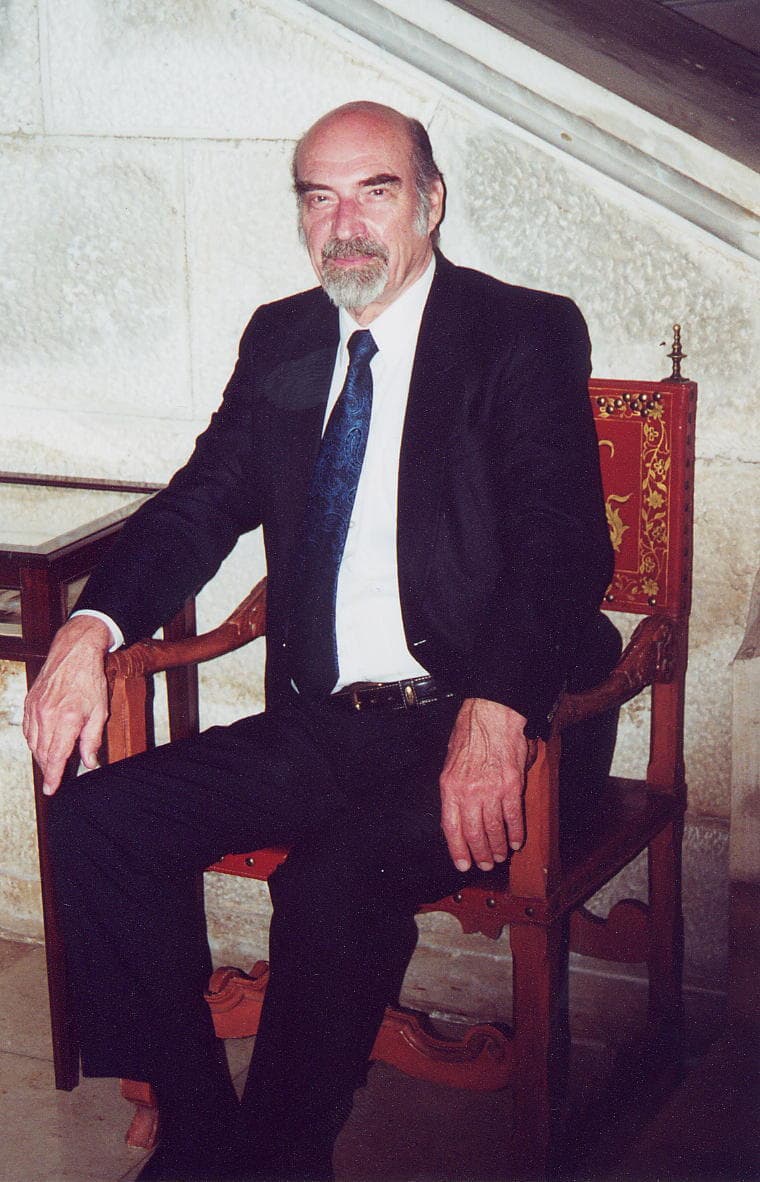
Read about Bernhard
He arrived in Hamilton, Ontario in 1955 and stayed for sixty-seven years. In that time he took pointfree topology from a handful of suggestive definitions to a theory that could stand beside the classical one — and in places replace it.
Marshall H. Stone
1903–1989 · Harvard · Chicago
His 1936 representation theorem turned Boolean algebras into spaces, and spaces into algebra. Every later duality in the subject is a variation on that exchange.
Charles Ehresmann
1905–1979 · Paris
Proposed in the 1950s that a lattice of opens is worth studying as a structure in its own right — the 'local lattices' that became frames.
Hugh Dowker & Dona Papert Strauss
1912–1982 · b. 1934 · London
Carried frame theory from a definition into a working toolkit through the 1960s and 70s, including the treatment of sublocales and separation.
John Isbell
1930–2005 · Buffalo
“Atomless parts of spaces” (1972) named the locale and insisted that the pointfree side was the better-behaved category, not a curiosity.
Bernhard Banaschewski
Full profile →1926–2022 · McMaster
Over two hundred papers that made the pointfree theory complete: compactification, real-valued functions, rings, and proofs that need no choice.
Christopher Mulvey
b. 1944 · Sussex
With Banaschewski, built the Stone–Čech compactification of locales and the localic form of Gelfand duality.
Peter Johnstone
b. 1948 · Cambridge
Stone Spaces (1982) gave the field its canonical text; “The point of pointless topology” (1983) gave it its manifesto.
Aleš Pultr
b. 1938 · Charles University, Prague
Banaschewski's long-running collaborator and, with Picado, author of the modern reference on frames and locales.
Jorge Picado
b. 1963 · Coimbra
Co-author of Frames and Locales (2012) and a steady custodian of the subject's literature and history.