Loading…
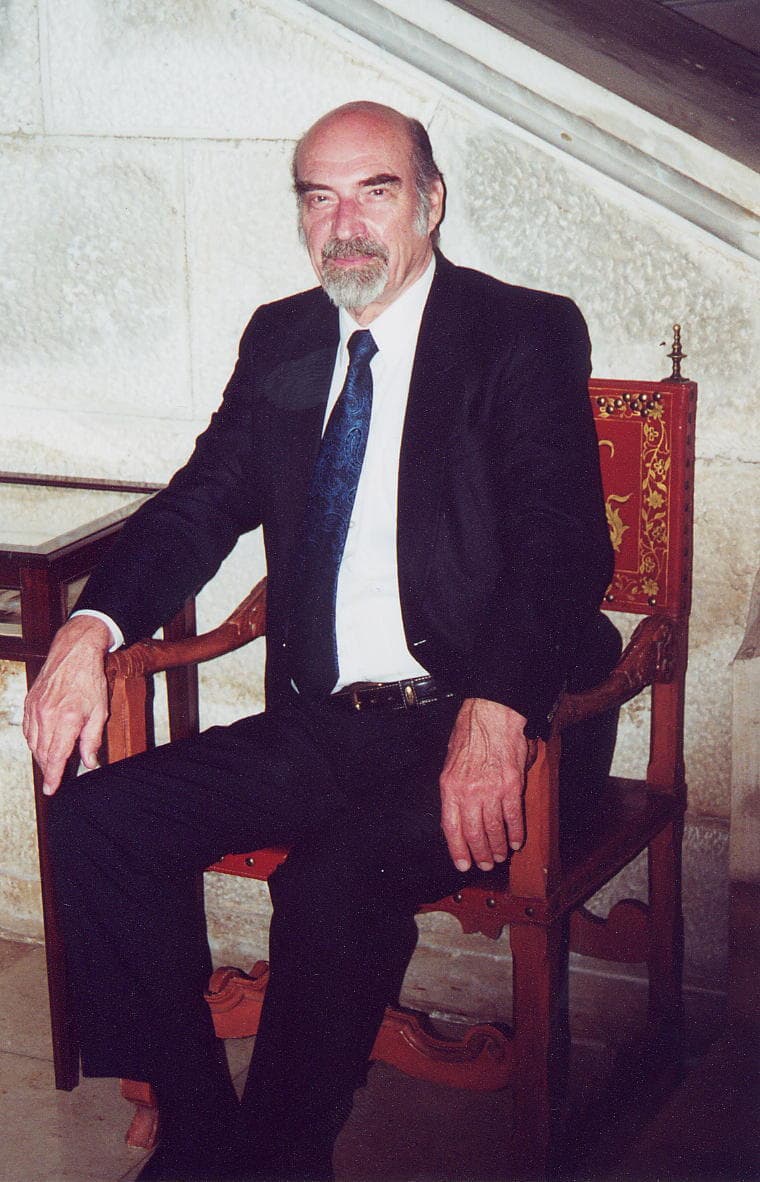
A life in one department
Bernhard
Banaschewski
22 March 1926 — 31 October 2022McKay Professor Emeritus, McMaster200+ papers
He arrived in Hamilton, Ontario in 1955 and stayed for sixty-seven years. In that time he took pointfree topology from a handful of suggestive definitions to a theory that could stand beside the classical one — and in places replace it.
The work
What he actually did
Banaschewski took his doctorate at the University of Hamburg under Ernst Witt, in a tradition of algebra that shows everywhere in his later work. He never treated topology as a subject about points that happened to admit a lattice-theoretic description. He treated the lattice as the subject.
The programme he pursued for half a century was deceptively simple: take a theorem of classical topology, ask what it says about opens alone, and find out whether the pointfree version is true, false, or — most interestingly — truer. Over and over the answer was the third one. The pointfree statement would turn out to hold under weaker hypotheses, or without the axiom of choice, or over an arbitrary topos rather than only over sets.
His 1957 paper Spaces of dimension zero gave the construction now called the Banaschewski compactification: the zero-dimensional counterpart of Stone–Čech, realised as the Stone space of the Boolean algebra of clopen sets. Two decades later, with Christopher Mulvey, he built the Stone–Čech compactification of a locale outright, in two papers of 1980 and 1984 that remain the foundation of the area. And he proved the result that turned compactification from a construction into a classification: the compactifications of a frame correspond, order isomorphically, to the strong inclusions on it.
Alongside that ran the long project on the pointfree reals and on rings of continuous real functions — what does C(L) mean when L has no points? — and the globalisation of Gelfand duality with Mulvey, which lifted a theorem about commutative C*-algebras over sets into a theorem that holds over any topos.
The points were never the subject. They were a convenient way of talking about the opens, and once you notice that, you can put them down.
In pictures
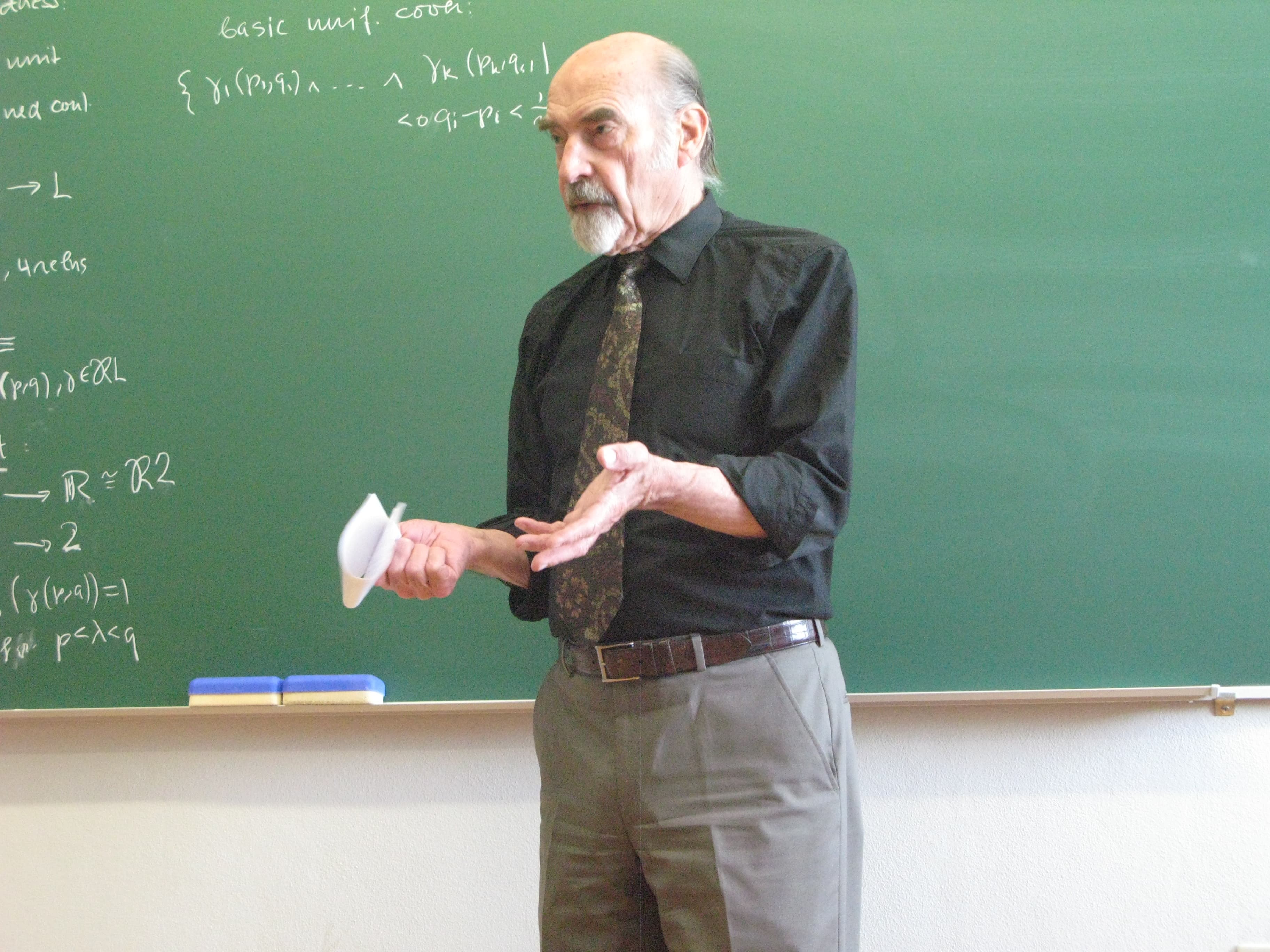
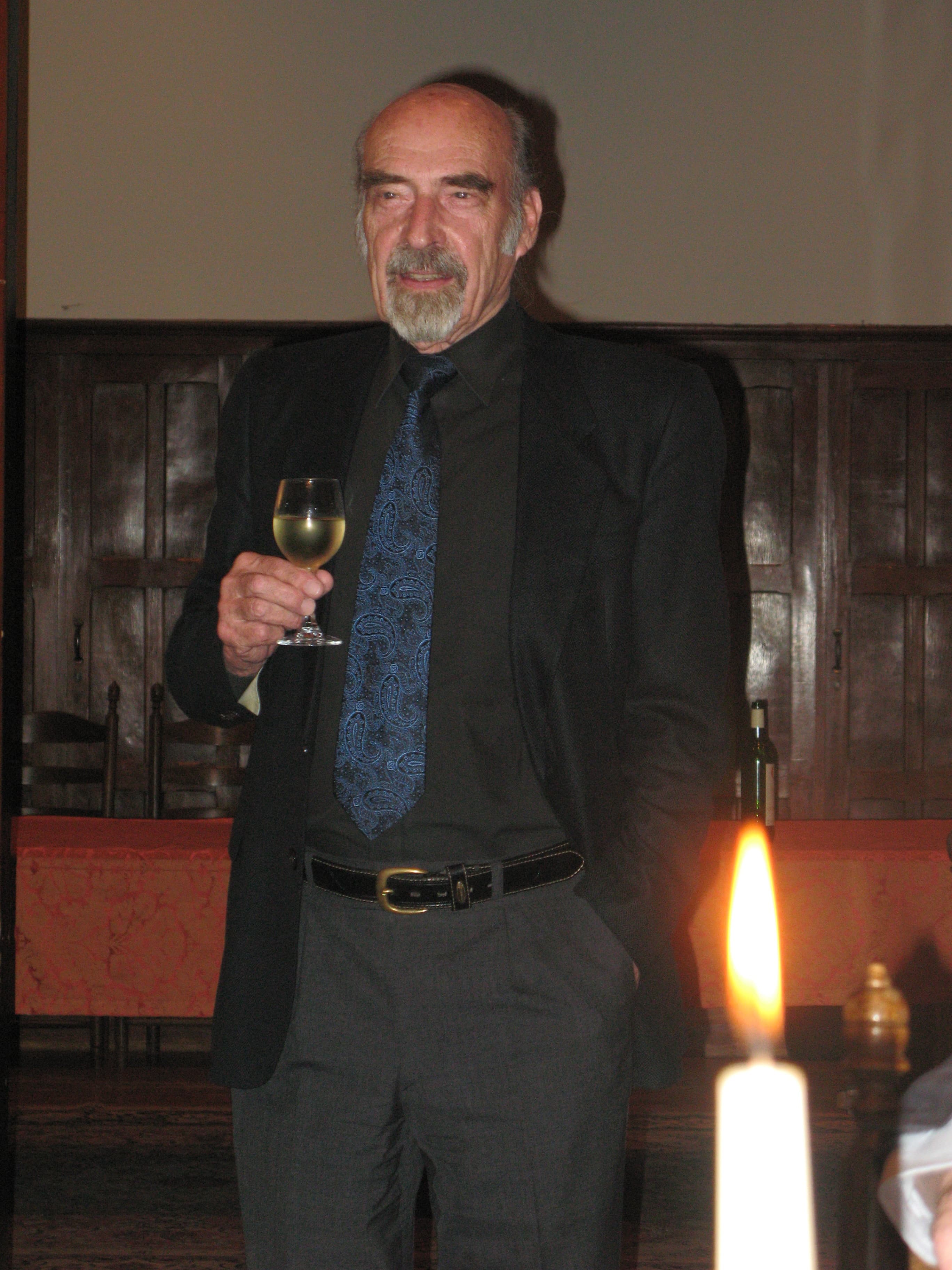
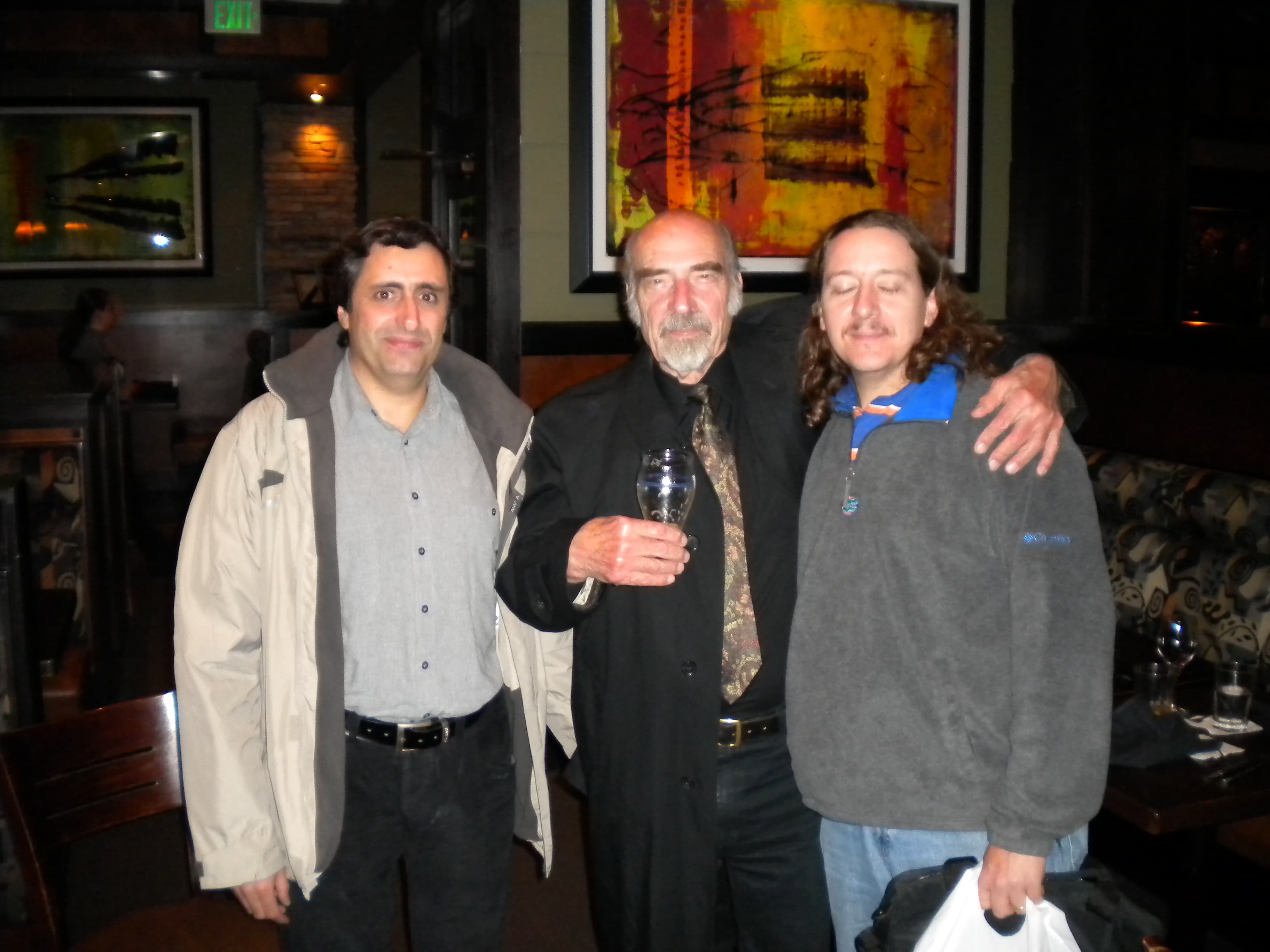
At the board, and away from it
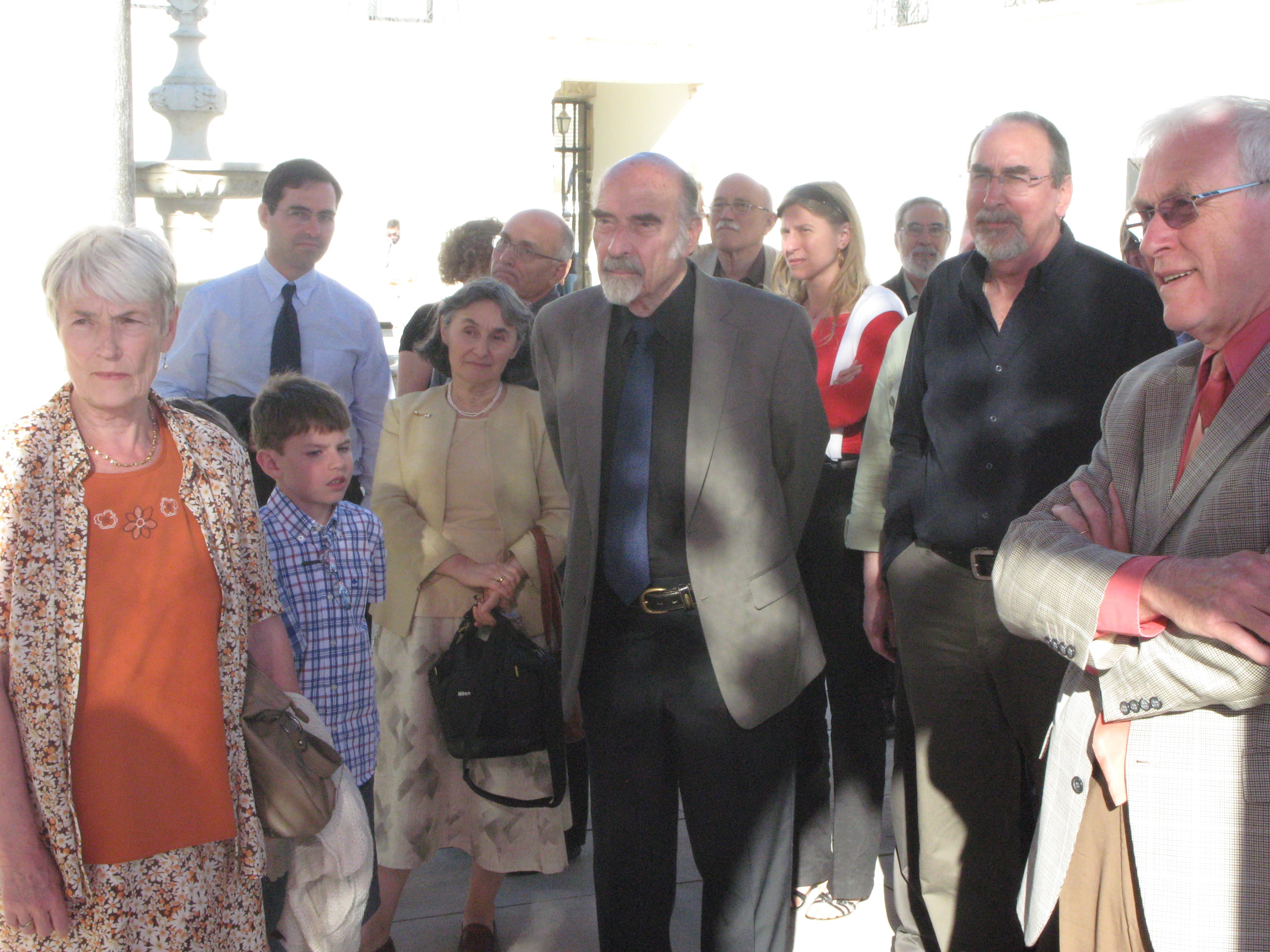
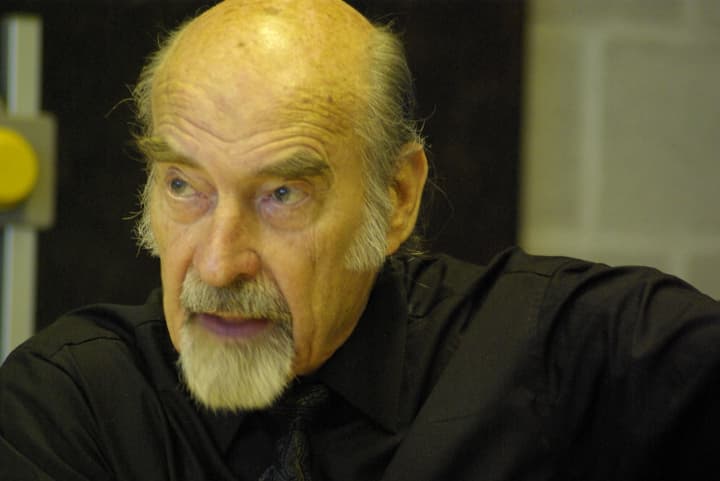

A life
Ninety-six years, one department
- 1926
Born 22 March in Munich.
- early 1950s
Doctorate at the University of Hamburg, supervised by Ernst Witt.
- 1955
Joins the Department of Mathematics at McMaster University in Hamilton, Ontario — the department he would stay with for the rest of his life.
- 1961–67
First term as Department Chair.
- 1962
Elected a Fellow of the Royal Society of Canada.
- 1964
Appointed McKay Professor of Mathematics.
- 1982–87
Second term as Department Chair.
- 1991
Retires as McKay Professor Emeritus — and keeps publishing.
- 2000
Honorary doctorate, University of Cape Town.
- 2017
Honorary degree from McMaster University.
- 2022
Dies on 31 October, aged 96.
Selected works
Six of more than two hundred
A full bibliography runs to several hundred entries. These are the ones a newcomer to pointfree topology is most likely to meet first.
1957
Spaces of dimension zero
Canadian Journal of Mathematics. The construction behind what is now called the Banaschewski compactification β₀X — the zero-dimensional analogue of Stone–Čech, realised as the Stone space of the Boolean algebra of clopen sets.
1980
Stone–Čech compactification of locales I
With C. J. Mulvey. Houston Journal of Mathematics. Builds the compactification entirely inside the lattice, with no appeal to points or to the axiom of choice.
1984
Stone–Čech compactification of locales II
With C. J. Mulvey. Journal of Pure and Applied Algebra. The sequel, and the paper most often cited as the start of serious pointfree compactification theory.
1997
The real numbers in pointfree topology
Textos de Matemática, Série B 12, Universidade de Coimbra. A book-length account of the pointfree reals and of rings of continuous real functions. Reissued in revised form by Springer in the Coimbra Mathematical Texts series.
2005
On the function ring functor in pointfree topology
Applied Categorical Structures 13. Treats C(L) as a functor and asks which of its classical properties survive the move away from points.
2006
A globalisation of the Gelfand duality theorem
With C. J. Mulvey. Annals of Pure and Applied Logic. Gelfand duality rebuilt so that it holds over an arbitrary base topos rather than only over sets.
He kept publishing for thirty years after he retired
Mathematics departments measure careers in appointments and chairs. Banaschewski's is better measured by the fact that the papers never stopped — and that the people who work on frames and locales today are, nearly all of them, working on questions he opened.